OREITHYIA
Greek Name
Ορειθυια
Transliteration
Oreithyia
Latin Spelling
Orithyia
Translation
Mountain-Raging
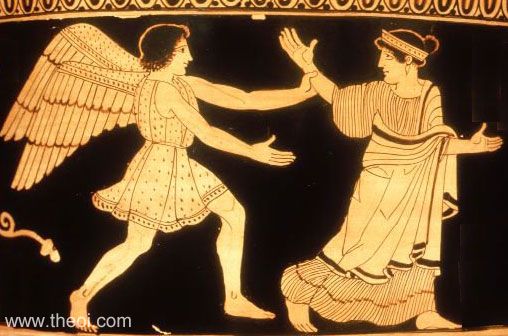
OREITHYIA (Orithyia) was the mountain-nymph wife of Boreas the North-Wind who dwelt with her husband in a cave on Mount Haimos (Haemus) in Thrake.
Oreithyia was once a mortal princess who was abducted by the god from the banks of the river Ilissos near Athens. He carried her off to Thrake where she became his immortal wife.
Oreithyia was probably the goddess of chill mountain winds for her name means "mountain-rager"--from the Greek words oreios and thyô--and she was named the mother of Khione (Snow).
Oreithyia's sisters Pandrosos (All Dewy) and Herse (Dew) were also minor Athenian deities. Oreithyia was probably the same as Khione (Chione) who was also described as the consort of the North Wind.
FAMILY OF ORITHYIA
PARENTS
[1.1] EREKHTHEUS & PRAXITHEA (Apollodorus
3.196, Pausanias 3.15.1)
[1.2] EREKHTHEUS (Simonides Frag 534, Herodotus 7.189, Apollonius Rhodius 1.212,
Diodorus Siculus 4.43.3, Hyginus Fabulae 14, Ovid Metamorphoses 6.679, Ovid Fasti 5.203, Nonnus Dionysiaca
37.155, Suidas s.v. Aphetai)
OFFSPRING
[1.1] ZETES, KALIAS (by Boreas) (Simonides
Frag 534, Apollonius Rhodius 1.212, Hyginus Fabulae 14, Ovid Metamorphoses 6.679, Propertius Elegies 1.20,
Suidas s.v. Gambros Erekhtheos)
[1.2] ZETES, KALAIS, KHIONE, KLEOPATRA (by Boreas) (Apollodorus 3.199, Apollonius Rhodius
2.234, Pausanias 3.15.2)
[1.3] KLEOPATRA (by Boreas) (Nonnus
Dionysiaca 2.686)
ENCYCLOPEDIA
OREITHYIA (Oreithuia). A daughter of Erechtheus and Praxithea. Once as she had strayed beyond the river Ilissus she was carried off by Boreas, by whom she became the mother of Cleopatra, Chione, Zetes. and Calais. (Apollod. iii. 15. § 1, &c.; Apollon. Rhod. i. 215; comp. Plat. Phaedr. p. 194, ed. Heiod.; Schol. ad Odyss. xiv. 533.)
Source: Dictionary of Greek and Roman Biography and Mythology.
CLASSICAL LITERATURE QUOTES
Simonides, Fragment Frag 534 (from Scholiast on Apollonius of Rhodes) (trans.
Campbell, Vol. Greek Lyric III) (C6th to 5th B.C.) :
"Simonides says that Orithyia was carried off from Brilessos and taken to the Sarpedonian rock in Thrake
(Thrace) . . . Orithyia was daughter of Erekhtheus (Erechtheus), and Boreas (the North Wind) carried her off
from Attika (Attica), too her to Thrake, had intercouse with her there and fathered Zetes and Kalais (Calais),
as Simonides tells in The Sea-Battle."
Pindar, Pythian Ode 4 ep8 (trans. Conway) (Greek lyric C5th B.C.) :
"And swift came [to join the Argonauts] two who dwelt beneath the strong foundations of Pangaion's
(Pangaeum's) height; for gladly with a joyful heart their father Boreas (the North Wind), sovereign of the
winds, commanded Zetes and Kalais (Calais) to the task, those heroes whose backs on either side bear fluttering
wings of purple."
Aeschylus, Oreithyia (lost play) (Greek tragedy C5th B.C.) :
This lost drama described Boreas' marriage suit for the Athenian princess Oreithyia, its rejection by her
father and his subsequent abduction of the maiden. Weir Smyth (L.C.L.) notes: "In the two extant fragments,
which are cited as examples of pseudo-tragic diction, Boreas, enraged at the rejection of his suit, threatens to
display his power in its full force.
Pseudo-Apollodorus, Bibliotheca 3. 196 (trans. Aldrich) (Greek mythographer C2nd
A.D.) :
"Erekhtheus (Erechtheus) [king of Athens] married Praxithea, daughter of Phrasimos and Kephisos'
(Cephisus') daughter Diogeneia, and had sons named Kekrops (Cecrops), Pandoros (Pandorus), and Metion, dand
daughters named Prokris (Procris), Kreusa (Creusa), Khthonia (Chthonia), and Oreithyia (Orithyia), whom Boreas
(the North Wind) kidnapped."
Pseudo-Apollodorus, Bibliotheca 3. 199 :
"As Oreithyia was playing by the river Ilissos, Boreas (the North Wind) kidnapped her and had sex with her.
She bore him daughters named Kleopatra (Cleopatra) and Khione (Chione), and winged sons named Zetes and Kalais
(Calais)."
Apollonius Rhodius, Argonautica 1. 212 ff (trans. Rieu) (Greek epic C3rd B.C.)
:
"[From the list of Argonauts :] Next came Zetes and Kalias (Calais), children of Boreas (the North Wind),
whom Oreithyia daughter of Erekhtheus (Erechtheus) had borne to Boreas in the wintry borderland of Thrake
(Thrace). It was from Attika (Attica) that Thrakian Boreas had brought her there. She was whirling in the dance
on the banks of Ilissos (Ilissus) when he snatched her up and carried her far away to a spot called Sarpedon's
Rock, near the flowing waters of Erginos, where he wrapped her in a dark cloud and overcame her. And now, these
sons of hers could soar into the sky. Astounding spectacle! As they flapped wings on either side of their
angles, a glint of gold shone through from spangles on the dusky feathers; an their black locks streaming from
head and neck along their backs were tossed by the wind to this side and that."
Apollonius Rhodius, Argonautica 2. 23 ff :
"The two sons of Boreas (the North Wind) . . . Phineos (Phineus), Agenor's son, who when he ruled in Thrake
(Thrace) won Kleopatra (Cleopatra), sister of that pair, with his bridal gifts and brought her to his."
Quintus Smyrnaeus, Fall of Troy 1. 166 ff (trans. Way) (Greek epic C4th A.D.)
:
"She [the Amazon Penthesilea] in pride of triumph on she rode throned on a goodly steed and fleet, the gift
of Oreithyia, wild Boreas' (North-wind's) bride, given to her guest the warrior-maid, what time she came to
Thrake (Thrace), a steed whose flying feet could match the Harpyiai's (Harpies') wings."
Herodotus, Histories 7. 189 (trans. Godley) (Greek historian C5th B.C.) :
"[During the historical war between the Greeks and the Persians :] The story is told that because of an
oracle the Athenians invoked Boreas, the North Wind, to help them, since another oracle told them to summon
their son-in-law as an ally. According to the Hellenic story, Boreas had an Attic wife, Orithyia, the daughter
of Erekhtheus (Erechtheus), ancient king of Athens. Because of this connection, so the tale goes, the
Athenians considered Boreas to be their son-in-law.
They were stationed off Khalkis (Chalcis) in Euboia (Euboea), and when they saw the storm rising, they then, if
they had not already, sacrificed to and called upon Boreas and Orithyia to help them by destroying the barbarian
[Persian] fleet, just as before at Athos. I cannot say whether this was the cause of Boreas falling upon the
barbarians as they lay at anchor, but the Athenians say that he had come to their aid before and that he was the
agent this time. When they went home, they founded a sacred precinct of Boreas beside the Ilissos (Ilissus)
river."
Plato, Phaedrus 229 ff (trans. Fowler) (Greek philosopher C4th B.C.) :
"Phaidros (Phaedrus) : I should like to know, Sokrates, whether the place is not somewhere here at which
Boreas (the North Wind) is said to have carried off Oreithyia from the banks of the Ilissos (Ilissus)?
Sokrates (Socrates) : Such is the tradition.
Phaidros : And is this the exact spot? The little stream is delightfully clear and bright; I can fancy that
there might be maidens playing near.
Sokrates : I believe that the spot is not exactly here, but about a quarter of a mile lower down, where you
cross to the temple of Artemis, and there is, I think, some sort of an altar of Boreas at the place.
Phaidros : I have never noticed it; but I beseech you to tell me, Sokrates, do you believe this tale?
Sokrates : The wise are doubtful, and I should not be singular if, like them, I too doubted. I might have a
rational explanation that Oreithyia was playing with Pharmakeia (Pharmaceia), when a northern gust carried her
over the neighbouring rocks; and this being the manner of her death, she was said to have been carried away by
Boreas. There is a discrepancy, however, about the locality; according to another version of the story she was
taken from Areopagos, and not from this place."
Strabo, Geography 7. 3. 1 (trans. Jones) (Greek geographer C1st B.C. to C1st A.D.)
:
"Sophokles (Sophocles), when in his role as a tragic poet he speaks of Oreithyia, tells how she was
snatched up by Boreas (the North Wind) and carried ‘over the whole sea to the ends of the earth and to the
sources of night and to the unfoldings of heaven and to [Hyperborea] the ancient garden of Phoibos (Phoebus)
[Apollon].'"
Pausanias, Description of Greece 1. 19. 5 (trans. Jones) (Greek travelogue C2nd A.D.)
:
"This Ilisos (Ilissus) [at Athens] is the river by which Oreithyia was playing when, according to the
story, she was carried off by Boreas (the North Wind). With Oreithyia he lived in wedlock, and because of the
tie between him and the Athenians he helped them by destroying most of the foreigners' warships. The Athenians
hold that the Ilisos is sacred to other deities as well."
Pausanias, Description of Greece 1. 38. 2 :
"[The hero] Eumolpos (Eumolpus) they say came from Thrake (Thrace), being the son of Poseidon and Khione
(Chione). Khione they say was the daughter of the wind Boreas and of Oreithyia."
Pausanias, Description of Greece 3. 15. 1-4 :
"Erekhtheus (Erechtheus) married Praxithea . . . and had sons . . . and daughters, to wit, Prokris
(Procris), Kreusa (Creusa), Khthonia (Chthonia), and Orithyia, who was carried off by Boreas . . .
While Orithyia was playing by the Ilissos (Ilissus) river, Boreas (the North Wind) carried her off and had
intercourse with her; and she bore daughters, Kleopatra (Cleopatra) and Khione (Chione), and winged sons, Zetes
and Kalais (Calais). These sons sailed with Jason and met their end in chasing the Harpyiai (Harpies); but
according to Akousilaos (Acusilaus), they were killed by Herakles in Tenos.
Kleopatra was married to Phineus, who had by her two sons, Plexippos and Pandion. When he had these sons by
Kleopatra, he married Idaia (Idaea), daughter of Dardanos. She falsely accused her stepsons to Phineus of
corrupting her virtue, and Phineus, believing her, blinded them both. But when the Argonauts sailed past with
the Boreades, they punished him.
Khione had connexion with Poseidon, and having given birth to Eumolpos (Eumolpus) unknown to her father, in
order not to be detected, she flung the child into the deep. But Poseidon picked him up and conveyed him to
Aithiopia (Ethiopia)."
Pausanias, Description of Greece 5. 19. 1 :
"[Depicted on the chest of Kypselos (Cypselus) dedicated at Olympia :] Boreas (the North Wind), who has
carried off Oreithyia; instead of feet he has serpents' tails."
Diodorus Siculus, Library of History 4. 43. 3 (trans. Oldfather) (Greek historian
C1st B.C.) :
"Kleopatra (Cleopatra), who men said was born of Oreithyia, the daughter of Erekhtheus (Erechtheus), and
Boreas."
Pseudo-Hyginus, Fabulae 14 (trans. Grant) (Roman mythographer C2nd A.D.) :
"Zetes and Calais, sons of the wind Aquilo (the North Wind) [Boreas] and Orithyia, daughter of Erechtheus.
These are said to have had wings on head and feet and dark-blue locks, and travelled by air . . . These, too,
are said to be from Thrace."
Pseudo-Hyginus, Fabulae 14 :
"Helmsmen [of the Argo] were Zetes and Calias, sons of Aquilo (the North Wind) [Boreas] who had wings on
head and feet."
Pseudo-Hyginus, Fabulae 19 :
"Zetes and Calais, sons of the North Wind and Orithyia."
Pseudo-Hyginus, Fabulae 157 :
"Sons of Neptunus [Poseidon] . . . Eumolpus by Chiona [Khione], daughter of Aquilo [Boreas]."
Ovid, Metamorphoses 6. 679 ff (trans. Melville) (Roman epic C1st B.C. to C1st A.D.)
:
"Erechtheus held the sceptre and control [of Athens] . . . Four sons he had, and four daughters also, two
of whom were matched in beauty; Procris was the happy bride of Cephalus, but Boreas (the North Wind) whose love
was Orithyia, found the ill-repute of Tereus and his Thracians damaging, and long he'd been without his heart's
desire while he preferred to woo with words not force. But when fair speeches failed him, anger stormed, the
North Wind's too familiar mood at home. ‘Yes, I deserved it! Why, oh, why,’ he said, ‘Did I
give up my armoury, my wrath, my blustering threats, my force, my savagery, and take to grovelling and disgrace
myself? Force is what fits me, force! . . . Such means I should have used my wife to gain; by force I should
have won, not wooed in vain!’
With words like these or others no less high, he waves his wings and, as they beat, the whole world felt the
blast and all the wide sea surged. Trailing his dusty cloak across the peaks, he swept the ground and, clothed
in darkness, wrapped terrified Orithyia in his wings, his loving tawny wings, and as he flew his fire was fanned
and flared. The ravisher held on his airy course until he reached the peopled cities of the Cicones [in
Thrace].
There the princess of Attica became wife of the icy king and mother too, mother of twins [the Boreades], who had
their father's wings, though all else from their mother. Ye the boys weren't born, it's said, with wings and,
while their beards were still ungrown below their auburn locks, both Calais and Zetes were unwinged. But later
as their cheeks grew yellow down, so, like a bird, wings lapped them on each side. And thus it was that when
their boyhood years gave place to manhood, with the Argonauts, on that first ship across the unknown sea they
sailed to seek the gleaming Golden Fleece."
Ovid, Fasti 5. 203 ff (trans.Boyle) (Roman poetry C1st B.C. to C1st A.D.)
:
"Boreas [the North Wind] gave his brother [Zephyros the West Wind] full rights of rape by robbing
Erechtheus' house of its prize [Oreithyia]."
Ovid, Heroides 16. 345 ff (trans. Showerman) (Roman poetry C1st B.C. to C1st A.D.)
:
"In the name of Aquilo (the North Wind) [Boreas] the Thracians took captive Erechtheus' child [Oreithyia],
and the Bistonian shore was safe from war [i.e. the Athenians did pursue]."
Ovid, Heroides 18. 37 ff :
"O Boreas (North Wind) . . . Cold as thou art, canst thou yet deny, base wind that of yore thou wert aflame
with Actaean fires?" [N.B. "Actaean" is Athenian, i.e. the Athenian princess Oreithyia.]
Propertius, Elegies 2. 26C (trans. Goold) (Roman elegy C1st B.C.) :
"Orithyia when ravished denied that even Boreas (the North Wind) was cruel: this god tames both the lands
and the deep seas."
Propertius, Elegies 3. 6 :
"Hateful Aquilo [Boreas], bane of ravished Orithyia."
Propertius, Elegies 1. 20 :
"Pursuing him [Hylas], two brothers, sons of Aquilo (the North Wind) [Boreas], now Zetes overtakes him, now
Calais overtakes, . . . But he at wing's length mocks them as they hover and wards off with a bough their winged
assault. At last they of Pandion's line, the sons of Orithyia, gave up."
Statius, Thebaid 12. 630 ff (trans. Mozley) (Roman epic C1st A.D.) :
"[The river] Elisos (Ilissus) who privy to Oreithyia's rape concealed beneath his banks the Thracian lover
[Boreas]."
Nonnus, Dionysiaca 1. 134 ff (trans. Rouse) (Greek epic C5th A.D.) :
"Aye Boreas (North Wind), I conjure thee, receive me on thy pinions in the air, as thou didst ravish thine
Athenian bride [Oreithyia]."
Nonnus, Dionysiaca 2. 686 ff :
"Phineus came with all speed to the Thrakian land. As for him, I [Zeus] will make him proud with his deep
mines of riches, and lead him as goodson to Oreithyia and Thrakian Boreas (North Wind), as prophetic bridegroom
of garlanded Kleopatra (Cleopatra)."
Nonnus, Dionysiaca 37. 155 ff :
"First Erekhtheus (Erechtheus) [king of Athens] brought his horse Xanthos (Bayard) under the yoke, and
fastened in his mare Podarkes (Swiftfoot); both sired by North-Wind Boreas . . . and the Wind [Boreas] gave them
as loveprice to his godfather Erekhtheus when he stole Attic Oreithyia for his bride."
Nonnus, Dionysiaca 47. 302 ff :
"[Ariadne is abandoned by Theseus on the island of Naxos :] She prayed to Boreas (the North Wind) and
adjured the wind, adjured Oreithyia [wife of Boreas] to bring back the boy [Theseus] to the land of Naxos and to
let her see that sweet ship again. She besought hardhearted Aiolos (Aeolus) yet more; he heard her prayer and
obeyed, sending a contrary wind to blow, but Boreas lovelorn himself cared nothing for the maid stricken with
desire."
Suidas s.v. Gambros Erekhtheos (trans. Suda On Line) (Byzantine Greek lexicon C10th
A.D.) :
"Gambros Erekhtheos (Son-in-law of Erekhtheos) : Borras (the North Wind) [Boreas]. For he married
Oreithuia, his [Erechtheus' (Erechtheus')] daughter, from whom were born Zetes and Kalais (Calais)."
Suidas s.v. Aphetai :
"Aphetai (Aphetae) : A place in Athens where the expedition of Xerxes [historical Persian general] had its
first setback because of the unsuitability of the harbors. For this reason they consider Boreas (the North Wind)
to be an ally of the Athenians. The god [Apollon of Delphoi] had prophesied that they should sacrifice to their
kinsman wind; he is called kinsman because of Oreithyia."
Suidas s.v. Parthenoi :
"Parthenoi (Maidens). This is how they called the daughters of Erekhtheus (Erechtheus) and honoured them;
they were six in number. The eldest was Protogenia, the second Pandora, the third Prokris (Procris), the fourth
Kreusa (Creusa), the fifth Oreithyia (Orithyia), the sixth Khthonia (Chthonia)."
ANCIENT GREEK ART
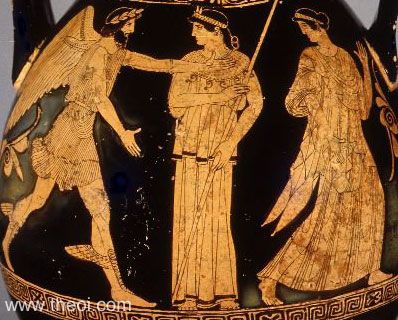
T28.3 Boreas, Athena, Oreithyia
Athenian Red Figure Vase Painting C5th B.C.
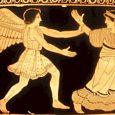
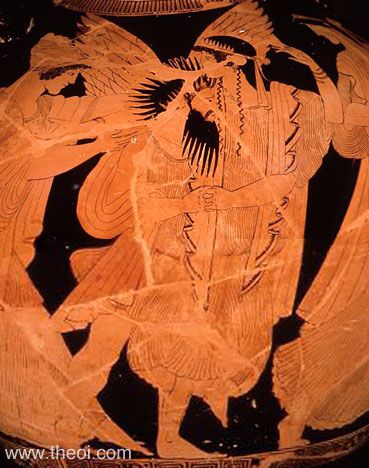
T28.2 Boreas & Oreithyia
Athenian Red Figure Vase Painting C5th B.C.
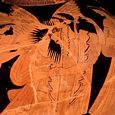
T28.4 Boreas & Oreithyia
Athenian Red Figure Vase Painting C5th B.C.
SOURCES
GREEK
- Pindar, Odes - Greek Lyric C5th B.C.
- Greek Lyric III Simonides, Fragments - Greek Lyric C6th - 5th B.C.
- Aeschylus, Fragments - Greek Tragedy C5th B.C.
- Herodotus, Histories - Greek History C5th B.C.
- Plato, Phaedrus - Greek Philosophy C4th B.C.
- Apollodorus, The Library - Greek Mythography C2nd A.D.
- Apollonius Rhodius, The Argonautica - Greek Epic C3rd B.C.
- Diodorus Siculus, The Library of History - Greek History C1st B.C.
- Strabo, Geography - Greek Geography C1st B.C. - C1st A.D.
- Pausanias, Description of Greece - Greek Travelogue C2nd A.D.
- Quintus Smyrnaeus, Fall of Troy - Greek Epic C4th A.D.
- Nonnus, Dionysiaca - Greek Epic C5th A.D.
ROMAN
- Hyginus, Fabulae - Latin Mythography C2nd A.D.
- Ovid, Metamorphoses - Latin Epic C1st B.C. - C1st A.D.
- Ovid, Fasti - Latin Poetry C1st B.C. - C1st A.D.
- Ovid, Heroides - Latin Poetry C1st B.C. - C1st A.D.
- Propertius, Elegies - Latin Elegy C1st B.C.
- Statius, Thebaid - Latin Epic C1st A.D.
BYZANTINE
- Suidas, The Suda - Byzantine Greek Lexicon C10th A.D.
OTHER SOURCES
Other references not currently quoted here: Scholiast on Homer's Odyssey 14.533, Scholiast on Apollonius Rhodius' Argonautica 1.212.
BIBLIOGRAPHY
A complete bibliography of the translations quoted on this page.