HERMES ESTATE
Greek Name
Ἑρμης
Transliteration
Hermês
Latin Spelling
Hermes
Translation
Mercury
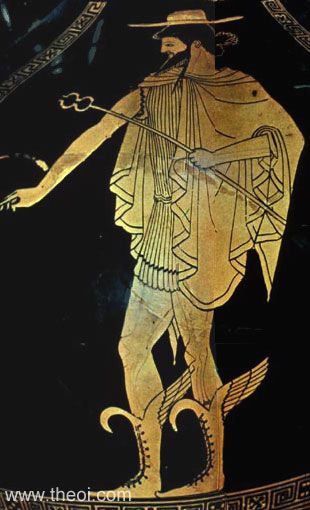
HERMES was the Olympian god of herds, trade, heralds, athletes and thieves.
This page describes the god's attributes, estate, sacred plants and animals, and attendant gods. Hermes' attributes in classical art were the herald's wand (Latin caduceus, Greek kerykeion), winged boots, a brimmed and sometimes winged cap (petasos), and a traveller's cloak (chlamys). His sacred animals were the tortoise, ram and hawk, and his plant the crocus flower.
(1) ESTATE & ATTRIBUTES
WINGED BOOTS Hermes wore a pair of winged boots which carried him through the sky as the herald of the gods.
CAP Hermes wore either a wide-brimmed travellers' cap or winged hat. The former was called the Cap of Aidoneus (the Unseen) for it rendered its wearer invisible.
HERALD'S ROD Hermes carried a golden "kerykeion" or herald's staff in his role as the messenger of the gods. He also used it to enduce slumber.
BLADE Hermes wielded a golden or adamantine blade.
SHEPHERD'S PIPES Hermes invented the shepherd's pipes, which he traded with Apollon the god of music for certain privileges. The god however continued to play this rustic instrument.
CATTLE Hermes obtained a herd of divine cattle from Apollon, which he herded in the sacred pastures of Mount Olympos.
(2) SACRED PLANTS & ANIMALS
HARE The hare was sacred to Hermes because of its proliferacy. He placed the animal amongst the stars as the constellation Lepus.
HAWK The hawk was a bird sacred to Hermes. The god transformed two men, Hierax and Daidalon, into hawks.
TORTOIS The tortoise was an animal sacred to Hermes. He transformed the nymphe Khelone into a tortoise and also constructed the first lyre from the shell of the beast.
CROCUS The crocus-flower, from which saffron was harvested in the mountains, was sacred to Hermes. The god was said to have caused it to grow from the blood of his beloved Krokos.
STRAWBERRY TREE The strawberry tree was regarded as sacred to Hermes, for he was said to have been nursed beneath the boughs of such a tree.
(3) ATTENDANTS OF HERMES
OREIADES (Oreads) The mountain-nymphs were companions of Hermes in the wilds of Arkadia.
PAN & PANES Pan the god of goat-herds and the tribe of goat-footed Panes were companions of Hermes in the Arkadian mountains.
SATYROI (Satyrs) The fertility-spirits of the wilds were companions of Hermes.
ONEIROI The dream-spirits were companions of Hermes Khthonios (Of the Underworld), who guided them forth from their subterranean realm to the minds of sleeping men.
CLASSICAL LITERATURE QUOTES
HERALD'S ROD (CADUCEUS) OF HERMES
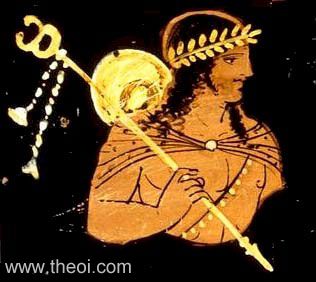
Hermes wielded a golden herald's staff as a symbol of his role as the herald of the gods. It was called kerykeion by the Greeks and caduceus by the Romans.
Homer, Iliad 24. 339 ff (trans. Lattimore) (Greek epic C8th B.C.) :
"He [Hermes] caught up the staff (rhabdos), with which he mazes the eyes of those mortals whose
eyes he would maze, or wakes again the sleepers. Holding this in his hands, Kratus (strong) Argeiphontes winged
his way onward."
Homer, Iliad 24. 443 ff :
"There were sentries . . . but about these the courier Argeiphontes drifted sleep, on all [with his
wand]."
Homer, Odyssey 5. 28 ff (trans. Shewring) (Greek epic C8th B.C.) :
"And he [Hermes] took the rod that lulls men's eyes for him, at his pleasure, or awakens others when they
slumber. With this in hand strong (kratus) Argeiphontes (Radiant One) began his flight."
Homer, Odyssey 24. 1 ff :
"Hermes Kyllenios (of Mt Kyllene) began to summon the suitors' ghosts [at dawn's first light]; he held in
his hand the golden rod that he uses to lull men's eyes asleep when he so wills, or again to wake others from
their slumber; with this he roused them and led them on [to the underworld], and they followed him, thinly
gibbering."
Homeric Hymn 4 to Hermes 528 ff (trans. Evelyn-White) (Greek epic C7th to 4th B.C.)
:
"Apollon sware also [to Hermes] : ‘Verily I will make you only to be an omen for the immortals and
all alike, trusted and honoured by my heart. Moreover, I will give you a splendid staff of riches and wealth: it
is of gold, with three branches, and will keep you scatheless, accomplishing every task, whether of words or
deeds that are good, which I claim to know through the utterance of Zeus.’"
Pseudo-Apollodorus, Bibliotheca 3. 115 (trans. Aldrich) (Greek mythographer C2nd
A.D.) :
"Hermes was tending the cattle, this time he fashioned a shepherd's pipe which he proceeded to play.
Covetous also of this, Apollon offered him the golden staff which he held when he herded cattle."
Pausanias, Description of Greece 5. 27. 8 (trans. Jones) (Greek travelogue C2nd A.D.)
:
"[At Olympia] is another image, Hermes with a herald's wand."
Orphic Hymn 28 to Hermes (trans. Taylor) (Greek hymns C3rd B.C. to 2nd A.D.)
:
"Hermes . . . messenger of Zeus . . . whose hand contains of blameless peace the rod, Korykion,
blessed."
Pseudo-Hyginus, Astronomica 2. 7 (trans. Grant) (Roman mythographer C2nd A.D.)
:
"At Apollo's request he [Hermes] gave him permission to claim the invention of the lyre, and received from
him a certain staff as reward. When Mercury [Hermes], holding it in his hand, was journeying to Arcadia and saw
two snakes with bodies intertwined, apparently fighting, he put down the staff between them. They separated
then, and so he said that the staff had been appointed to bring peace. Some, in making caducei, put two snakes
intertwined on the rod, because this seemed to Mercury a bringer of peace. Following his example, they use the
staff in athletic contests and other contests of this kind."
Ovid, Metamorphoses 1. 583 ff (trans. Melville) (Roman epic C1st B.C. to C1st A.D.)
:
"[Hermes] grasped in his fist the wand that charms to sleep, put on his magic cap, and thus arrayed . . .
sprang from his father's citadel down to earth [to slay the monster Argos Panoptes]. There he removed his cap,
laid by his wings; only his wand he kept . . . Cyllenius [Hermes] saw all Argus' eyelids closed [after soothing
him with the music of a shepherd's-pipe] and every eye vanquished in sleep. He stopped and with his wand, his
magic wand, soothed the tired resting eyes and sealed their slumber."
Ovid, Metamorphoses 2. 708 ff :
"The god with his wand, his magic wand, opened the door."
Ovid, Metamorphoses 2. 730 ff :
"[Hermes] saw that his wand, the wand he wields to bring and banish sleep, shone with a polish."
Ovid, Metamorphoses 11. 301 ff :
"Mercurius [Hermes] with his wand that soothes to slumber touched her [Khione] on the lips; touch-tranced
she lay and suffered his assault [he lay with her]."
Statius, Thebaid 4. 410 ff (trans. Mozley) (Roman epic C1st A.D.) :
"Cloud-wrapt Arcadian [Hermes] with rod of power leads in separate throng [the Shades of] the pious
denizens of Elysium."
Apuleius, The Golden Ass 10. 30 ff (trans. Walsh) (Roman novel C2nd A.D.) :
"The herald's staff and the wand which he carried identified him as Mercurius [Hermes]."
Nonnus, Dionysiaca 5. 562 ff :
"All that dwelt in Olympos were bewitched by this one girl [Persephone], rivals in love for the
marriageable maid, and offered their dowers for an unsmirched bridal. Hermes . . . offered his rod as gift to
adorn her chamber [as bride-price for her hand-in-marriage, but Demeter declined all offers]."
WINGED BOOTS & CAP OF HERMES
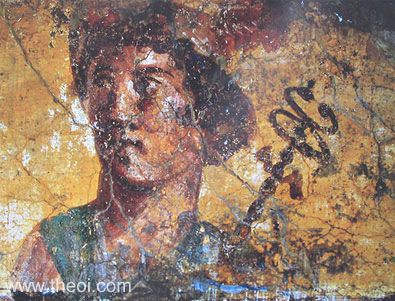
Hermes wore winged, short leather boots called by the Greeks pteroeis pedila and by the Romans talaria. His wide-brimmed felt cap was the hat of Aidoneus (the Unseen) which rendered its wearer invisible.
Homer, Iliad 24. 339 ff (trans. Lattimore) (Greek epic C8th B.C.) :
"The courier (diaktoros) Argeiphontes. Immediately he bound upon his feet the fair sandals
(pedila) golden (khryseia) and immortal (ambrosia), that carried him over the water
as over the dry land of the main abreast of the wind's blast. He caught up the staff (rhabdos), with
which he mazes the eyes of those mortals whose eyes he would maze, or wakes again the sleepers. Holding this in
his hands, strong (kratus) Argeiphontes winged his way onward."
Homer, Odyssey 5. 28 ff (trans. Shewring) (Greek epic C8th B.C.) :
"At once he [Hermes] fastened under his feet the immortal sandals of lovely gold that carried him, swift as
airy breezes, over ocean and over boundless earth. And he took the rod that lulls men's eyes for him, at his
pleasure, or awakens others when they slumber. With this in hand strong (kratus) Argeiphontes (Radiant
One) began his flight."
Pseudo-Apollodorus, Bibliotheca 2. 37 & 46 (trans. Aldrich) (Greek mythographer
C2nd A.D.) :
"With Hermes and Athena as his guides Perseus sought out .. . the Nymphai who kept certain treasures of the
gods - winged sandals, the kibisis (a sack), and the helmet of Haides . . .
[After his quest was complete] Perseus gave the sandals, kibisis, and helmet back to Hermes . . . Hermes
returned the aforementioned articles to the Nymphai."
Orphic Hymn 28 to Hermes (trans. Taylor) (Greek hymns C3rd B.C. to 2nd A.D.)
:
"Hermes . . . With winged feet 'tis thine through air to course."
Pseudo-Hyginus, Fabulae 64 (trans. Grant) (Roman mythographer C2nd A.D.) :
"Perseus, flying on Mercurius' [Hermes'] winged sandals."
Ovid, Metamorphoses 1. 583 ff (trans. Melville) (Roman epic C1st B.C. to C1st A.D.)
:
"He [Hermes] fastened on his ankle-wings, grasped in his fist the wand that charms to sleep, put on his
magic cap, and thus arrayed . . . sprang from his father's citadel down to earth. There he removed his cap, laid
by his wings; only his wand he kept."
Ovid, Metamorphoses 2. 730 ff :
"[Hermes] saw that his . . . ankle-wings were lustrous and his sandals brushed and clean."
Apuleius, The Golden Ass 10. 30 ff (trans. Walsh) (Roman novel C2nd A.D.)
:
"Tiny wings of gold were projecting from his [an actor playing Hermes'] locks, in which they had been
fastened symmetrically on both sides."
Nonnus, Dionysiaca 3. 373 ff (trans. Rouse) (Greek epic C5th A.D.) :
"Finerod Hermes departed, fanning his light wings, and the flat of his extended shoes oared him as quick as
the winds of heaven in their course."
Nonnus, Dionysiaca 9. 59 ff :
"Hermes was off into the sky unapproachable, twirling in the air the windswift soles of his shoes."
Nonnus, Dionysiaca 24. 270 ff :
"Nimbleknee Perseus, waving his winged feet, held his course near the clouds, a wayfarer pacing through the
air . . . with Hermes' wings . . . he sailed a fugitive on swiftest shoes."
GOLDEN BLADE OF HERMES
The weapon of Hermes was a golden blade, from which he received the epithet "Of the Golden Blade." He was depicted wielding this golden sword in the war between the gods and the Gigantes.
Pseudo-Apollodorus, Bibliotheca 2. 37 (trans. Aldrich) (Greek mythographer C2nd A.D.)
:
"He [Perseus] also received from Hermes a sickle made of adamant."
Ovid, Metamorphoses 1. 583 ff (trans. Melville) (Roman epic C1st B.C. to C1st A.D.)
:
"Heaven's master [Zeus] could no more endure Phoronis' [Io's] distress [a captive of Hera's guard, the
hundred-eyed giant Argos Panoptes], and summoned his son [Hermes] . . . and charged him to accomplish Argus'
death . . . [and he] with his sword struck off the nodding head [of Argos] and from the rock threw it all
bloody, spattering the cliff with gore."
Ovid, Metamorphoses 5. 176 ff :
"Perseus struck and thrust him [the Aithiopian Ekhemon] through with Cyllenius' [Hermes'] curved
blade."
CATTLE-HERD OF HERMES
A herd of divine cattle which the god won from Apollon. They grazed upon the sacred meadows of Mount Olympos.
Homeric Hymn 4 to Hermes 68 & 115 & 190 & 490 ff (trans. Evelyn-White)
(Greek epic C7th to 4th B.C.) :
"Hermes came hurrying to the shadowy mountains of Pieria, where the divine cattle of the blessed gods had
their steads and grazed the pleasant, unmown meadows. Of these the Son of Maia, the sharp eyed
(euskopos) slayer of Argos (Argeiphontes) then cut off from the herd fifty loud-lowing kine,
and drove them straggling-wise across a sandy place . . .
And kindling the fire, he dragged out two lowing, horned cows close to the fire; for great strength was with
him. He threw them both panting upon their backs on the ground, and rolled them on their sides, bending their
necks over, and pierced their vital chord. Then he went on from task to task: first he cut up the rich, fatted
meat, and pierced it with wooden spits, and roasted flesh and the honourable chine and the paunch full of dark
blood all together. He laid them there upon the ground, and spread out the hides on a rugged rock: and so they
are still there many ages afterwards, a long, long time after all this, and are continually . . .
[Apollon came seeking his cattle, and asked an old man if he had seen them :] ‘Old man, weeder of grassy
Onkhestos, I am come here from Pieria seeking cattle, cows all of them, all with curving horns, from my herd.
The black bull was grazing alone away from the rest, but fierce-eyed hounds followed the cows, four of them, all
of one mind, like men. These were left behind, the dogs and the bull--which is great marvel; but the cows
strayed out of the soft meadow, away from the pasture when the sun was just going down.’ . . .
[Apollon agrees to give Hermes the cattle in return for the lyre :] ‘This song of yours is worth fifty
cows, and I believe that presently we shall settle our quarrel peacefully.’ . . .
He [Hermes] held out the lyre : and Phoibos Apollon took it, and readily put his shining whip in Hermes' hand,
and ordained him keeper of herds. Afterwards they two, the all-glorious sons of Zeus turned the cows back
towards the sacred meadow, but themselves hastened back to snowy Olympos, delighting in the lyre."
SHEPHERD'S PIPE OF HERMES
Pseudo-Apollodorus, Bibliotheca 3. 115 (trans. Aldrich) (Greek mythographer C2nd
A.D.) :
"As Hermes was tending the cattle, this time he fashioned a shepherd's pipe which he proceeded to play.
Covetous also of this, Apollon offered him the golden staff which he held when he herded cattle. But Hermes
wanted both the staff and proficiency in the art of prophecy in return for the pipe. So he was taught how to
prophesy by means of pebbles, and gave Apollon the pipe."
Ovid, Metamorphoses 1. 583 ff (trans. Melville) (Roman epic C1st B.C. to C1st A.D.)
:
"[Hermes disguised himself as a] herdsman [in order to slay the giant Argos Panoptes], he drove a flock of
goats through the green byways, gathered as he went, and played his pipes of reed. The strange sweet skill
charmed Juno's [Hera's] guardian. ‘My friend,’ he called, ‘whoever you are, well might you sit
with me here on this rock, and see how cool the shade extends congenial for a shepherd's seat.’
So Atlantiades [Hermes] joined him, and with many a tale he stayed the passing hours and on his reeds played
soft refrains to lull the watching eyes. But Argus fought to keep at bay the charms of slumber and, though many
of his eyes were closed in sleep, still many kept their guard. He asked too by what means this new design (for
new it was), the pipe of reeds, was found. Then the god told this story [of Pan and his pursuit of the Nymphe
Syrinx] . . . The tale remained untold; for Cyllenius [Hermes] saw all Argus' eyelids closed and every eye
vanquished in sleep. He stopped and with his wand, his magic wand, soothed the tired resting eyes and sealed
their slumber."
SACRED BIRDS & ANIMALS
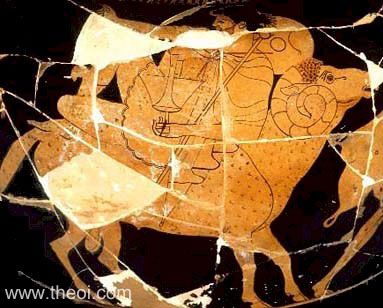
I. TORTOISE (Greek khelone)
Hermes created a lyre from its shell, and transformed the lazy nymphe Khelone into one. The fable of the tortoise and hare perhaps demonstrates why this--and not the faster creature--was his animal.
Pausanias, Description of Greece 2. 19. 6-7 (trans. Jones) (Greek travelogue C2nd
A.D.) :
"Within the temple is a statue of . . . Hermes with a tortoise which he has caught to make a lyre."
For MYTHS of Hermes and the tortoise see:
(1) Hermes & the Invention of the Lyre (creates first lyre from a
tortoise-shell)
(2) Hermes Wrath: Chelone (transforms nymph into tortoise)
II. RAM (Greek krios)
Hermes was often depicted in classical art carrying a ram in his arms.
Pausanias, Description of Greece 2. 3. 4 (trans. Jones) (Greek travelogue C2nd A.D.)
:
"We see a bronze image of a seated Hermes. By him stands a ram, for Hermes is the god who is thought most
to care for and to increase flocks . . . The story told at the mysteries of the Mother [Demeter] about Hermes
and the ram I know but do not relate."
Pausanias, Description of Greece 4. 33. 4 :
"There are statues of the gods . . . Hermes carrying a ram."
Pausanias, Description of Greece 5. 27. 8 :
"[A statue of] Hermes carrying the ram under his arm, with a helmet on his head, and clad in tunic and
cloak."
Pausanias, Description of Greece 9. 22. 1 :
"Hermes averted a pestilence from the city [of Tanagra] by carrying a ram round the walls; to commemorate
this alamis made an image of Hermes carrying a ram upon his shoulders."
Pseudo-Hyginus, Astronomica 2. 19 (trans. Grant) (Roman mythographer C2nd A.D.)
:
"Triangle [Triangulum]. This constellation ... Mercury [Hermes] is thought to have placed it above the head
of Aries (the Ram), so that the dimness of Aries might be marked by its brightness."
III. HAWK (Greek hierax)
Aelian, On Animals 12. 4 (trans. Schofield) (Greek natural history C2nd to 3rd A.D.)
:
"There are in fact several species of Hawks . . . They are allotted separately to many gods . . . the
ocypterus is a servant of Apollon . . . [and] the dove-killer is said to be the darling of
Hermes."
For MYTHS of Hermes and the hawk see:
(1) Hermes Wrath: Hierax (transforms the man into a hawk)
(2) Hermes Loves: Chione (transforms her father into a hawk)
IV. HARE (Greek lagos)
Pseudo-Hyginus, Astronomica 2. 33 (trans. Grant) (Roman mythographer C2nd A.D.)
:
"Hare [constellation Lepus]. Some say that it was put there by Mercurius [Hermes], and that it had been
given the faculty, beyond other kinds of quadrapeds, of being pregnant with new offspring when giving birth to
others."
SACRED PLANTS & FLOWERS
I. CROCUS (Greek krokos)
The story of the transformation of Hermes beloved Krokos into the flower of the same name is not currently quoted here.
II. STRAWBERRY-TREE (Greek andrakhnos)
Pausanias, Description of Greece 9. 22. 2 (trans. Jones) (Greek travelogue C2nd A.D.)
:
"In the sanctuary of [Hermes] Promakhos (the Champion) [in Tanagra, Boiotia] is kept all that is left of
the wild strawberry-tree (andrakhnos) under which they believe that Hermes was nourished."
For MORE information and pictures of sacred plants see FLORA OF MYTH
ATTENDANTS : OREADS & SATYRS
Homeric Hymn 5 to Aphrodite 256 ff (trans. Evelyn-White) (Greek epic C7th to 4th
B.C.) :
"The deep-breasted Mountain Nymphai [i.e. Oreades] who inhabit this great and holy mountain . . . with them
the Seilenoi (Silens) and the sharp-eyed Argeiphontes [Hermes] mate in the depths of pleasant caves."
For MORE information on these nature-spirits see OREIADES and SATYROI
SOURCES
GREEK
- Homer, The Iliad - Greek Epic C8th B.C.
- Homer, The Odyssey - Greek Epic C8th B.C.
- The Homeric Hymns - Greek Epic C8th - 4th B.C.
- Apollodorus, The Library - Greek Mythography C2nd A.D.
- Pausanias, Description of Greece - Greek Travelogue C2nd A.D.
- The Orphic Hymns - Greek Hymns C3rd B.C. - C2nd A.D.
- Aelian, On Animals - Greek Natural History C2nd - 3rd A.D.
- Nonnus, Dionysiaca - Greek Epic C5th A.D.
ROMAN
- Hyginus, Fabulae - Latin Mythography C2nd A.D.
- Hyginus, Astronomica - Latin Mythography C2nd A.D.
- Ovid, Metamorphoses - Latin Epic C1st B.C. - C1st A.D.
- Apuleius, The Golden Ass - Latin Novel C2nd A.D.
BIBLIOGRAPHY
A complete bibliography of the translations quoted on this page.